
Our Traditions
Patron Saints of Hatters and Milliners in the UK
In Medieval Europe, trade guilds commonly adopted patron saints as spiritual protectors and symbols of communal identity. Several saints were historically invoked as patrons of hatters, milliners and related trades in Britain, linking spiritual protection, craft identity, and communal cohesion.
St Catherine’s Day
In England Saint Catherine was traditionally known as the patron saint of lace-makers. In Medieval times November 25th was known as Catterntide and was marked by the baking of Cattern cakes. These are small biscuit-like cakes with the key ingredients of flour, eggs, sugar, lard or butter and caraway seeds. Why should that be of interest to milliners? Well carry on reading and you will be surprised.
In many Catholic countries this saint was considered as a protector of young women. In France on Saint Catherine’s day young single women used to pray to Saint Catherine for a husband.
“Donnez-moi, Seigneur, un mari de bon lieu! Qu’il soit doux, opulent, liberal et agréable!” (“Lord, give me a well situated husband. Let him be gentle, rich, generous and pleasant!”)
Catherinettes
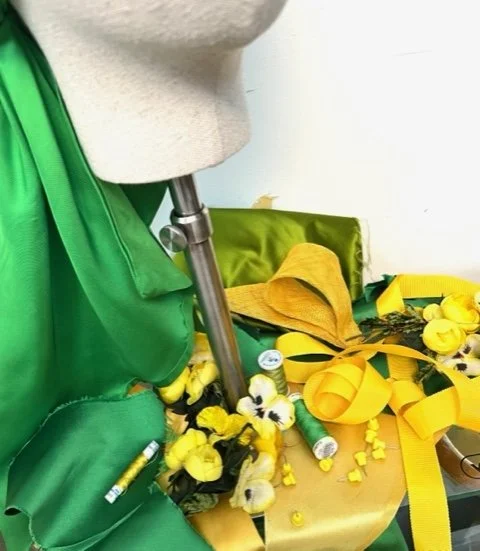
At the beginning of the1900s, Saint Catherine was adopted by the Parisian fashion industry, and milliners. A ‘fete de Catherinettes’ would be celebrated, on November 25th, young single women under the age of 25 would become ‘Catherinettes' whereupon their friends would make fanciful hats for them using materials in Saint Catherine’s colours - yellow for faith and green for wisdom.
They would parade to the Statue of Catherine (there are 2 in Paris) where a hat would be placed on the statue and the Catherinettes would be crowned and then wear their hats made of yellow and green for the duration of the celebrations. The day would continue with fancy dress parties and a ball in Saint Catherine’s honour.
Since those days social attitudes have changed and most people would look upon women praying for a husband as outdated. Since the 1970s this tradition is no longer celebrated on such a large scale, but it still continues in many Paris fashion houses.
These festivities on Saint Catherine’s day have been adopted in several countries around the world with hat makers and milliners putting on a parade, partying and while the event can be used as an opportunity to show off their skills, it is mainly treated now as a time for some fun away from work and not to find a husband.
This account is a short resume of information collected from various online sources.
Dillon Wallwork
St Clement
Bishop of Rome, 1st Century AD
St Clement became the patron saint of metalworkers, blacksmiths, mariners, felt-makers, and hatters.
Legend tells that on a long journey, he placed wool in his sandals to ease his aching feet. The warmth, pressure, and moisture are said to have turned the wool into felt. Though it’s unlikely that he invented the creation of felt, St Clement’s story influenced his choice as a guardian to those utilising felt within their craft, such as the hatters.
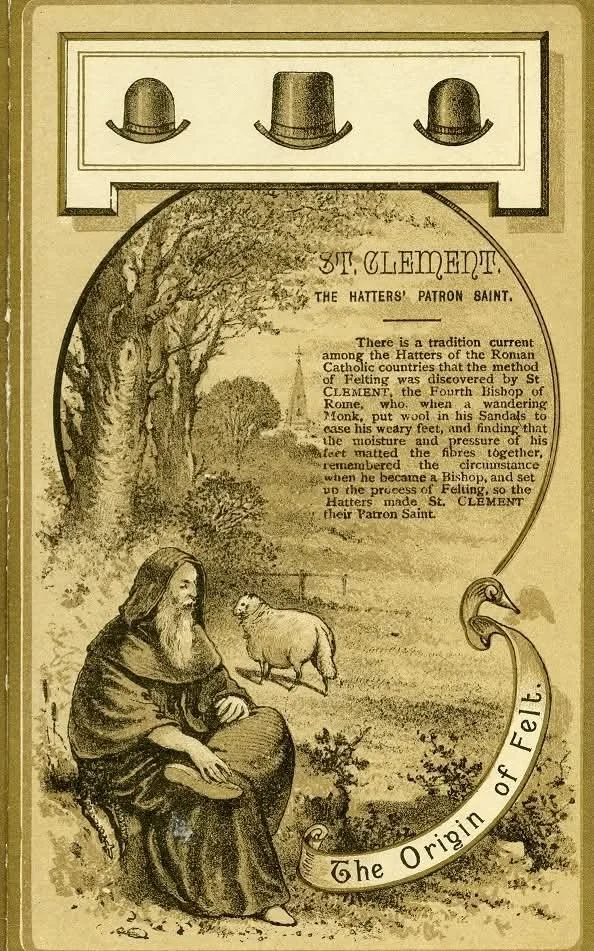
image courtesy of Hat Works Museum, Stockport
Up until the late 20th century, in the hat-making regions of Lancashire, Cheshire, and Atherstone (Warwickshire), his feast day, 23rd November, was joyously marked as ‘Clemensing’. Hatters would share a hearty supper, dance, and sing together, while children roasted apples and pears by the fire. In later years, workroom tea parties replaced the old festivities, but as the trade declined, sadly, so too did the tradition.
Several other patron saints have been linked to hatters over the centuries. In Tudor London, the Hat-makers’ Fraternity of St James placed itself under the protection of St James the Less, whose feast day falls on 1 May, 3 May, or 23 October, depending on the church tradition. St Severus of Ravenna, a wool weaver, and St Philip the Apostle have also been cited as patron saints of hat-makers, most likely through medieval guild customs. Their feast days are observed on 1 February and 1 May respectively.
Centuries later, as the hatting industry changed and apprenticeships through trade guilds faded, many of these patron saint celebrations have disappeared. Remembering these traces of devotion reminds us that hat-making was never just a trade, but a fellowship once guided by spiritual patrons, not to be forgotten.
Fleur Curtis